
Gedung Kuliah I (GK I) FBSB UNY
Jl. Colombo No. 1 Yogyakarta 55281
Telp. (0274) 550843, 546719, Fax (0274) 548207
Website: pbi.fbs.uny.ac.id
Email: kaprodi.pbi@uny.ac.id
 Bahasa Indonesia
 English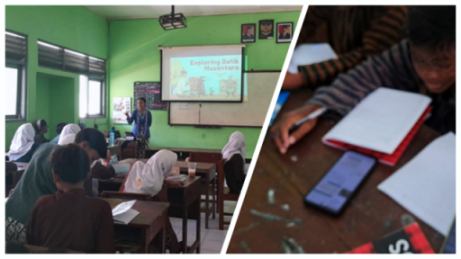
Bantul, Yogyakarta — September 11, 2026 — SMP Negeri 3 Bantul held a co-curricular program for the 2026/2027 academic year from August 31 to September 4, 2026. The program was conducted during the seventh week of the UNY Educational Practicum (PK) and involved all students of SMP Negeri 3
Bantul. For seventh-grade students, the program featured a special theme, “The Exploration of Batik Nusantara,” which was designed to strengthen, deepen, and enrich students’ classroom learning while also supporting character development.
The co-curricular program provided students with contextual learning experiences by connecting classroom lessons with the cultural environment around them. Through the activities, students gained not only theoretical knowledge but also opportunities to develop their skills through exploration, collaboration, creativity, and hands-on practice. This approach supports Sustainable Development Goal (SDG) 4: Quality Education, which emphasizes the importance of providing quality education and opportunities for students to develop a wide range of competencies.
Around 224 seventh-grade students participated in the “The Exploration of Batik Nusantara” program. At the same time, the co-curricular program was conducted simultaneously for all students, with different themes for each grade level. Eighth-grade students explored “Bantul Regional Folktales,” while ninth-grade students focused on “The Spirit of Democracy.” The activities were accompanied by teachers and UNY Educational Practicum students assigned to SMP Negeri 3 Bantul. One of them was Sarah Oktifa Riffandjani, a student from the English Education Study Program at Universitas Negeri Yogyakarta, who assisted English co-curricular activities in classes VII E, VII F, and VII G.
On the first day, students explored the diversity of Indonesian batik. They learned about various batik motifs from different regions, including Batik Parang, Batik Kawung, Batik Megamendung, and Batik Sekar Jagad, among others. The activity was not only intended to introduce batik as part of Indonesia’s cultural heritage but also encouraged students to observe the characteristics, identities, and unique features of the motifs they selected.
The cultural exploration was then integrated into English learning, particularly Descriptive Text. Using the Genre-Based Approach (GBA) and Project-Based Learning (PjBL), students were guided to develop simple descriptive texts about the Indonesian batik motifs they had explored. Through GBA, students progressed through several stages, beginning with Building Knowledge of the Field, followed by Modeling of the Text, Joint Construction of the Text, and Independent Construction of the Text. This process enabled students to gradually build their knowledge, examine model texts, work collaboratively, and eventually develop their own descriptive texts independently.
As part of the English project, students created English-language posters and infographics containing the identity and information about their selected batik motifs. After completing their group projects, they presented their work to their classmates. The activity gave students opportunities to use English in both written and spoken forms while developing their communication and collaboration skills.
The implementation of “The Exploration of Batik Nusantara” demonstrates that quality education can take place not only inside the classroom but also through contextual learning experiences that are closely connected to students’ lives. By integrating English learning with the exploration of Indonesian culture, students had the opportunity to develop their language skills while learning about and appreciating Indonesia’s cultural heritage.
Through this co-curricular program, SMP Negeri 3 Bantul contributed to the achievement of SDG 4: Quality Education by providing learning experiences that were active, contextual, collaborative, and focused on students’ overall competency development. English learning became more meaningful as students not only studied language structures but also applied English to explore and introduce the richness of Indonesian culture through Batik Nusantara.
Contributor: Sarah Oktifa Riffandjani